
Introduction
If you’ve ever reheated leftovers and ended up with a cold center and overcooked edges, you’ve met the limits of traditional microwave control. Microwey steps in with a different approach: smart, multi-point sensing and adaptive power control that tune heating in real time. In this guide, I’ll unpack what Microwey is, how its sensors work, where the benefits show up in everyday cooking, and how to choose, use, and care for a sensor-driven microwave so your results finally match your expectations.
What Is Microwey?
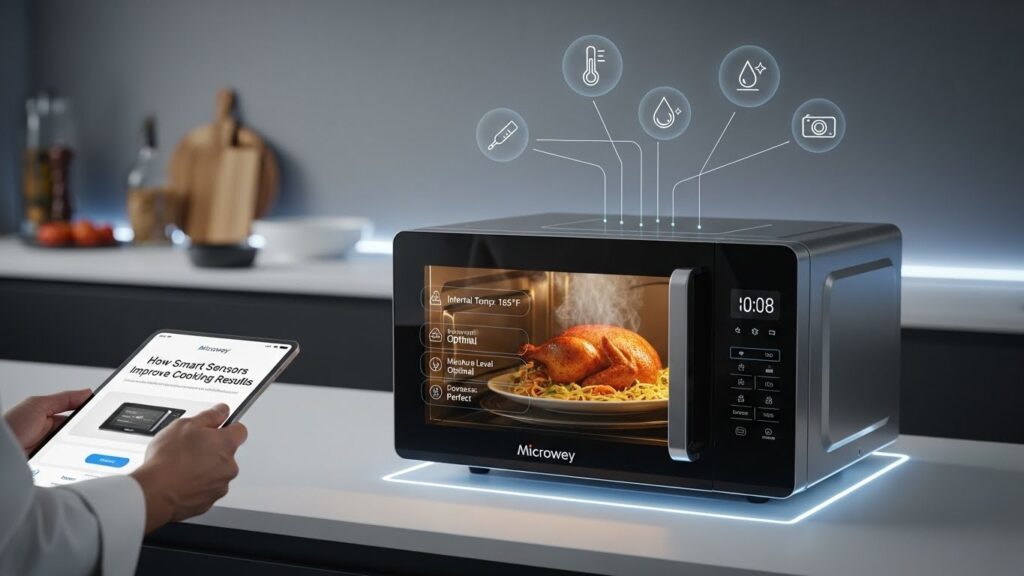
Microwey refers to a class of microwave ovens that combine embedded sensors, edge computing, and algorithmic control to monitor food doneness and adjust output automatically. Rather than relying on a simple timer and a fixed power level, Microwey devices read signals—steam, temperature, impedance, and motion—then nudge magnetron or solid-state power to avoid hot spots, dryness, and undercooked centers.
Key capabilities at a glance
- Multi-sensor arrays: humidity, temperature, infrared, and load sensing
- Adaptive power shaping: modulates duty cycle and, on solid-state units, frequency steering
- Food-type recognition: presets that learn from usage data
- Predictive doneness: estimates remaining time based on heat absorption patterns
How Smart Sensors Work
Humidity and steam sensing
As water heats, steam escapes and raises cavity humidity. Microwey’s humidity sensor samples these changes several times per second. When steam spikes, the system infers that surface moisture has reached boiling and begins tapering power to prevent boil-over and rubbery textures.
Temperature mapping
Some models use IR thermopiles to read surface temperature while thermistors track ambient cavity temps. Paired together, they let the controller avoid overshooting target temperatures when reheating sauces, soups, and delicate proteins.
Load and impedance feedback
By measuring how the food load reflects microwave energy (impedance), Microwey can tell whether the interior is absorbing energy efficiently. If reflection rises—often a sign the outer layer is dry—the algorithm redistributes power or inserts rest intervals to allow heat soak.
Motion and weight detection
Turntable motion data plus a high-resolution scale under the cavity floor help detect boil-over wobble and splatter risk. If mass drops rapidly (evaporation) or shifts (sudden bubble release), Microwey reduces power and extends time to preserve texture.
Why Microwey Improves Results
More even heating
- Multi-point sensing identifies cold zones and prevents edge scorching.
- Pulse-and-rest cycles let heat conduct inward, smoothing temperature gradients.
Better texture and moisture
- Steam thresholds cue the system to lower power for tender reheats.
- Frequency steering on solid-state designs penetrates differently sized foods more evenly.
Reduced guesswork
- Predictive timers adapt to portion size and starting temperature.
- Food-type recognition recommends modes with one-button simplicity.
Energy and time efficiency
- Avoiding overshoot means fewer reheat cycles.
- Adaptive power uses only what’s needed, cutting wasted minutes.
Everyday Use Cases
Reheating leftovers
- Pizza: IR sensing preserves crispy crust by alternating lower power with short convection bursts (on combo models).
- Rice and grains: Humidity cues trigger a steam cover routine to rehydrate evenly.
- Pasta with sauce: Temperature mapping separates sauce control from noodle warming.
Cooking from scratch
- Vegetables: Power ramps match cell-wall softening phases to keep color and snap.
- Fish and poultry: Surface IR and internal impedance feedback steer power to prevent dry edges and raw centers.
- Eggs: Micro-pulses and short rests build custardy curds without rubberizing.
Defrosting
- Weight and impedance feedback detect ice pockets and pause for heat soak, reducing gray bands and partial cooking.
Choosing a Microwey Model
Sensor set and control type
- Entry: Humidity + temperature sensors, magnetron power control
- Mid: Adds load/impedance feedback and finer duty-cycle modulation
- Premium: Solid-state RF with frequency agility, full sensor suite, and algorithm updates
Capacity and layout
- 0.9–1.2 cu ft works for singles and small kitchens.
- 1.5–2.2 cu ft better fits families, meal prep, and large platters.
- Look for flatbed (no turntable) if you want more usable space and easier cleaning.
Interface and presets
- Clear, descriptive modes (Reheat Plate, Soup, Grain Bowl) beat numeric codes.
- Editable targets for temperature and doneness offer more control for enthusiasts.
Integration and updates
- App connectivity can log results, push firmware updates, and add seasonal presets.
- Voice control is handy but should be optional and privacy-transparent.
Setup and Best Practices
First-time calibration
- Run the built-in water heat test to calibrate humidity thresholds.
- Set your altitude in the app so boiling-point logic is accurate.
Containers and covers
- Use microwave-safe glass or ceramic; avoid metallic trim.
- Vent covers or damp paper towels help regulate steam for grains and veggies.
Staging and stirring
- For dense foods, pause halfway to stir; the algorithm will adjust the second half.
- Arrange items in a ring on plates to improve exposure.
Clean sensors regularly
- Wipe the humidity port and IR window weekly to maintain accuracy.
- Keep the cavity dry between uses to avoid false-positive steam readings.
Troubleshooting Smarter
If centers are still cool
- Increase target temperature for “Plate Reheat” by 5–10°F.
- Use the “Dense Foods” profile, which extends rest phases for heat soak.
If edges dry out
- Enable moisture-guard mode or add a vented cover.
- Lower the maximum power ceiling for delicate items like fish and pastry.
If defrost starts cooking
- Switch to weight-based defrost and confirm the portion size.
- Break apart pieces when prompted so impedance sensing can read evenly.
Safety and Care
Food safety
- Verify safe internal temps: poultry 165°F, leftovers 165°F, ground meats 160°F.
- Rest meats after heating to allow carryover and even distribution.
Appliance safety
- Don’t operate empty; the system needs a load to absorb energy.
Maintenance
- Replace charcoal filters (on convection/hood combos) per schedule.
- Inspect door seals; a snug close preserves efficiency and sensor accuracy.
The Future of Microwey
As solid-state RF drops in cost, consumer units will gain finer-grained control, steering energy to specific zones while sensors build a live model of doneness. Expect shared recipe profiles, auto-learning from your history, and better cross-mode coordination with convection, air fry, or steam. In short, Microwey points to a kitchen where you tell the oven what outcome you want—and the sensors handle the rest.
Quick Start Checklist
- Unbox, connect to app, run calibration water test
- Set altitude and preferred doneness levels
- Stock vented covers and microwave-safe containers
- Try three core routines this week: Plate Reheat, Vegetable Steam, Weight Defrost
- Clean sensor windows after messy cooks and review logs to fine-tune